SERVICE
Turn invisible risks into numbers.
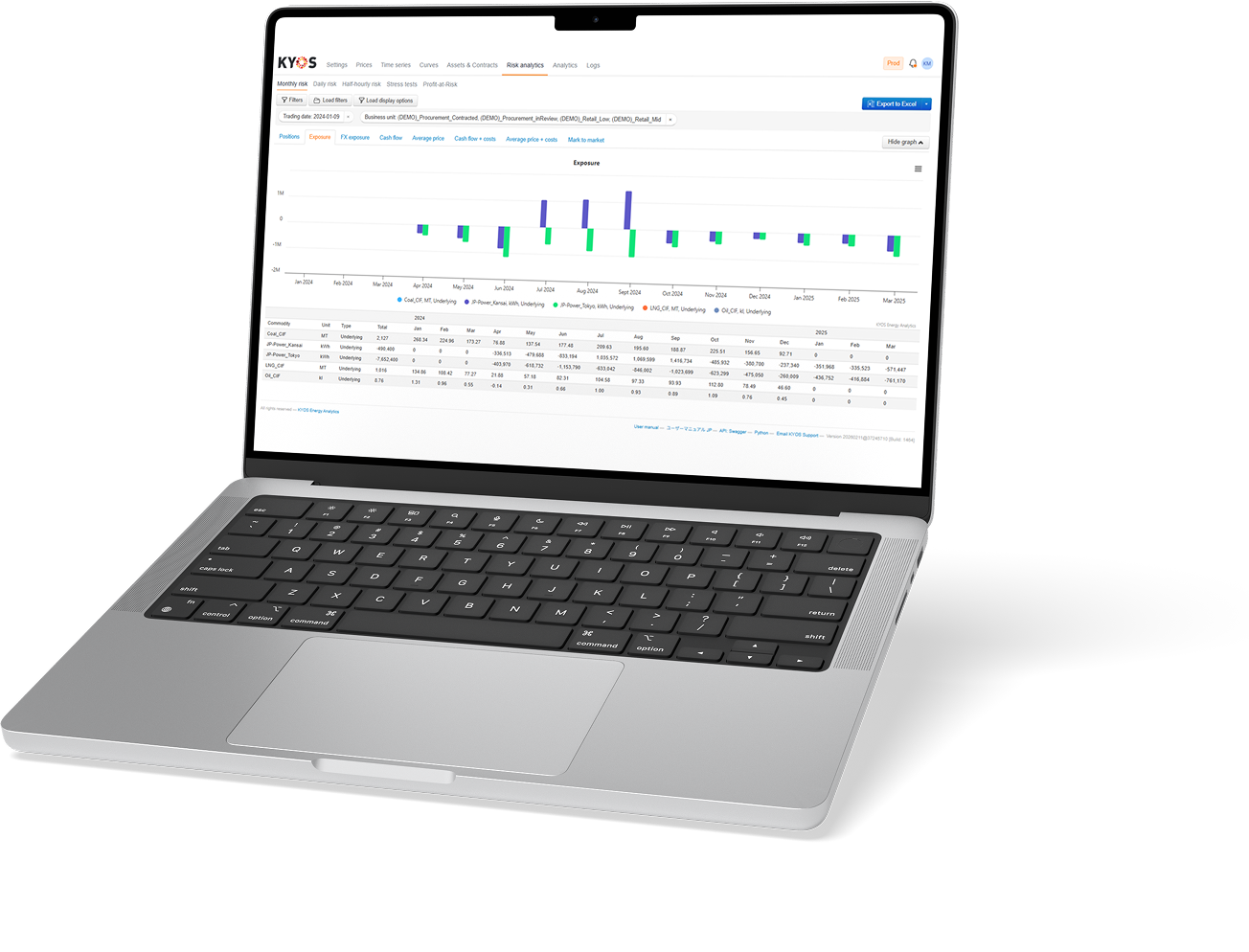

"Both power generators and retail electricity providers face price fluctuation risks (wholesale electricity prices and fuel prices) on both the sales and procurement sides, but as portfolios become more complex, it is not easy to visualize the impact of these fluctuations on their financial balance."

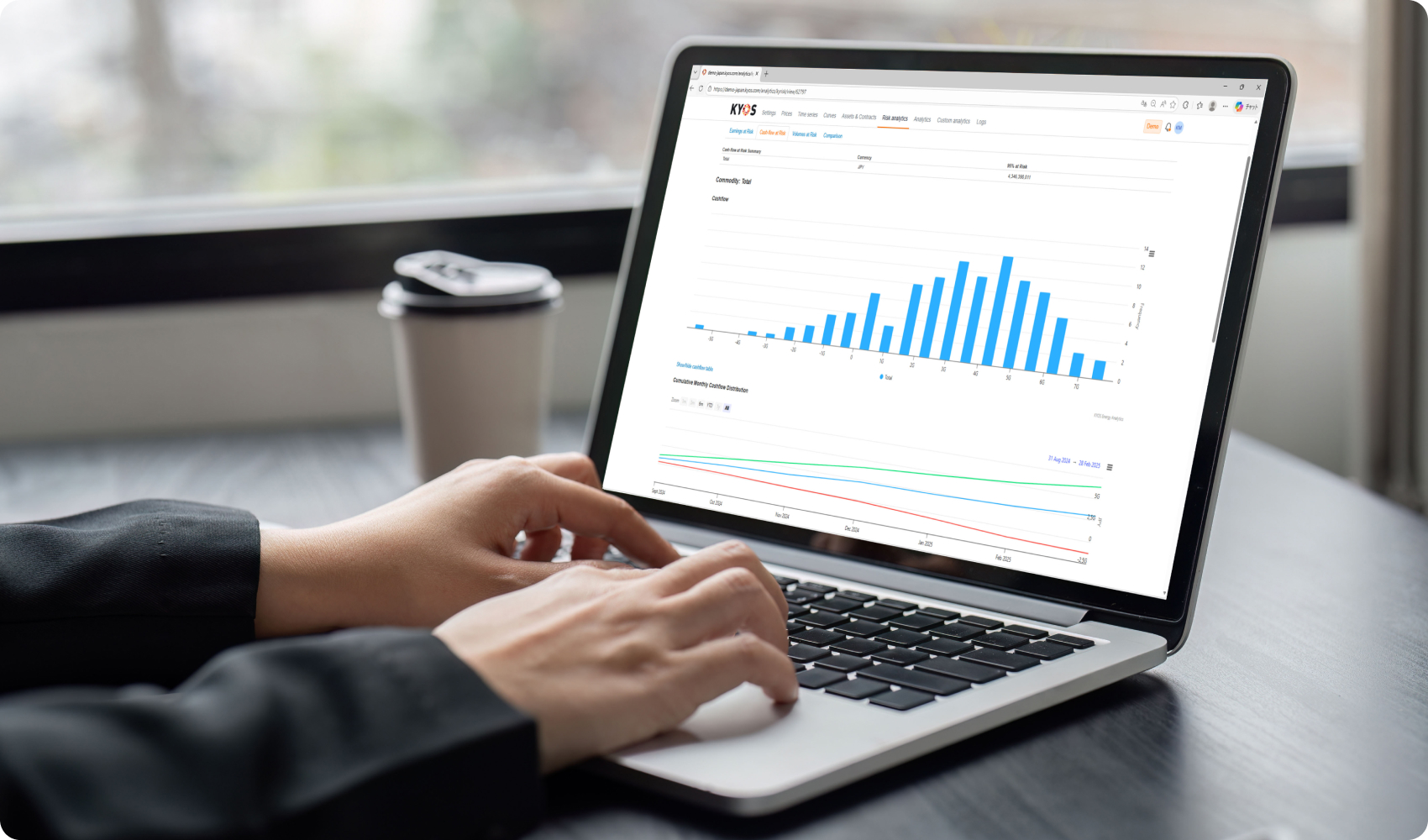
By entering your company's sales and procurement contract information once, you can quickly visualize risk indicators such as Net Exposure1 and EaR2 (the range of financial fluctuations).
1. An index representing the amount of price fluctuation risk among each index (such as the Japan Electric Power Exchange spot market price, the All Japan Customs Clearance LNG/Coal/Crude Oil Price (JLC/J-Coal/JCC)).
2. Abbreviation for Earnings at Risk.
01

In recent years, Japanese companies have increasingly concluded long-term contracts for U.S.-sourced LNG¹, and domestically, bilateral power transactions incorporating the Henry Hub (HH) price² into fuel cost adjustment clauses have also been on the rise³.
MPX-ETRM enables the assessment of price fluctuation risks for a variety of fuel price indices, including HH, as well as JKM⁴ and NEWC⁵.
*However, due to data usage rights, customers are required to provide price data for indices other than the All-Japan customs-cleared price (e.g., HH, JKM, NEWC).

Recently, the Agency for Natural Resources and Energy’s advisory committee has been discussing the introduction of a quantitative supply capacity obligation for retail electricity providers¹, as well as the establishment of a Medium- to Long-Term Trading Market².
Going forward, retail electricity providers, particularly those that have primarily relied on spot market procurement, may face increasing diversification and complexity in their procurement portfolios; however, MPX-ETRM is capable of adapting to such changes.
1,2. Denki Shimbun, “[Beyond Reform: Key Issues in System Design] (1) Discipline for Retailers / Medium- to Long-Term Trading Market” (September 8, 2025)
02

By considering the specifications of each power plant (output, power generation efficiency, minimum operating/downtime, startup costs, etc.), it is possible to evaluate how much a power plant's revenue may fluctuate in response to changes in the spot market price of electricity and fuel prices, assuming optimal operation of the power plant.

In addition to market price uncertainty, the profitability of renewable energy sources is evaluated by considering the uncertainty of power generation and the correlation between market price and power generation.

For swing contracts (wholesale contracts in which the deadline for exercising volume adjustment rights is set close to delivery), it is possible to evaluate the economic value of optimizing the exercised volume of such contracts while taking into account the uncertainty of electricity spot market prices.
03

The latest price data, such as electricity prices and fuel prices, is automatically imported.
Compared to risk management using Excel, etc., this method significantly reduces the workload of on-site personnel.
What kind of output (charts, data) can I obtain?
In addition to wholesale procurement and retail contracts, can power sources (thermal power, battery storage, solar power) also be included in the portfolio?
Do you handle not only spot trading but also futures trading?
Can you handle fuel cost adjustment unique to your company, other than those provided by former general electricity utilities?
How far into the future can we measure the risks?
Entering data into the system seems complicated; can I choose the method of integration?
How much time and preparation is required for implementation?
Do you offer a trial?